Medically reviewed by Mr Maneesh Ghei, Consultant Urological Surgeon (GMC: 5208045)
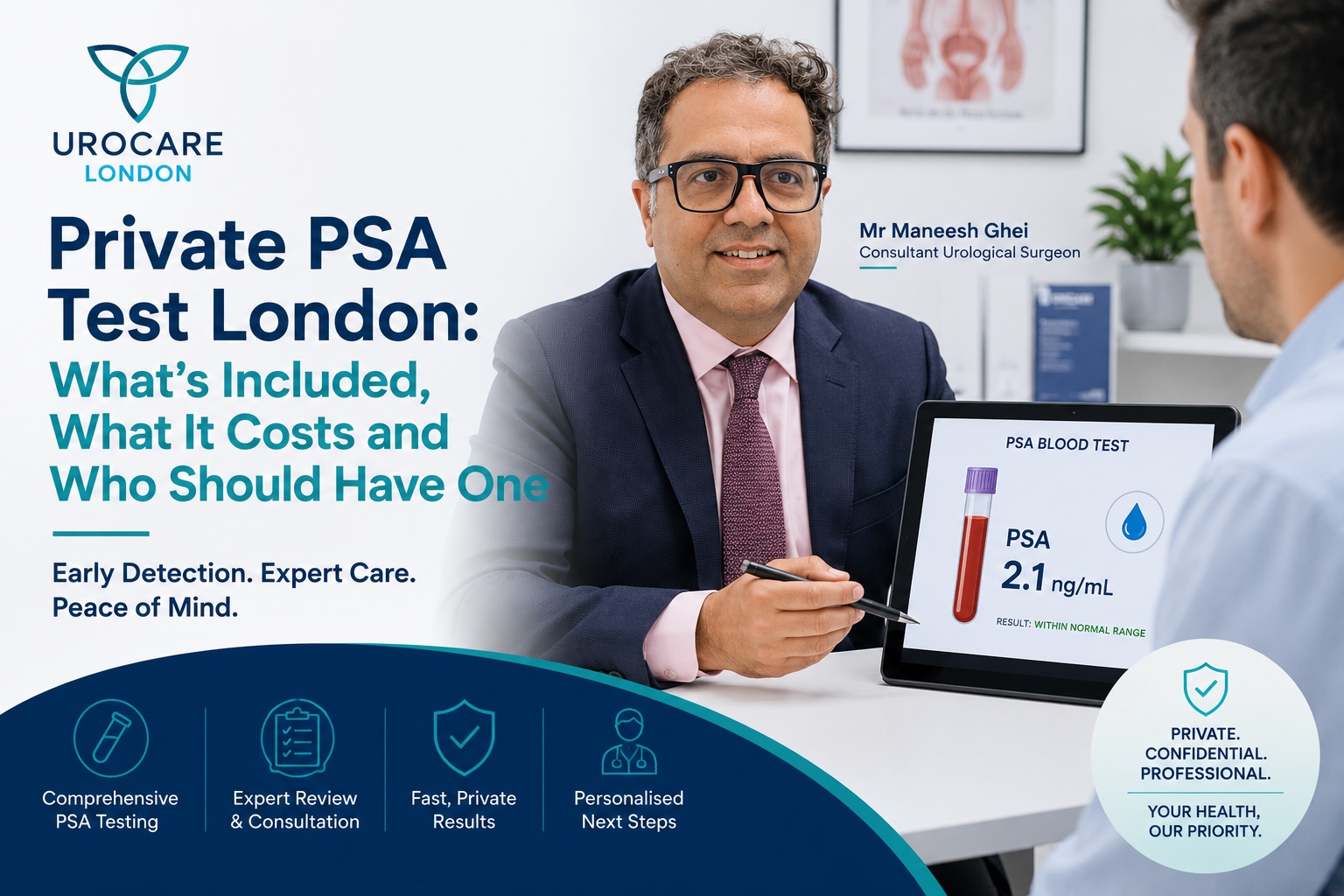
A private prostate test in London is a simple PSA blood test that takes around 5 minutes and returns a result inside 3 working days. At Urocare London the consultation, examination and PSA pathway costs £296 with no GP referral needed and same-week appointments at 4 London hospital locations.
We accept self-pay and insurance patients.
Demand for private testing has risen sharply since Jeremy Clarkson urged UK men to get checked, and many readers searching for “private PSA test” want to know what is actually involved, what it costs and whether it is right for them – this page answers all three.
Key Takeaways
- A private PSA test at Urocare London costs £296 and includes Consultant review, PSA blood test and urine analysis
- No GP referral is needed and both self-funded and insured Patients are welcome
- The test itself takes around 5 minutes with results returned in 2 to 3 working days
- If your PSA is raised, a multiparametric MRI scan from £737 is the next step before any biopsy is considered
- All men aged 50 and over should consider a baseline PSA test, with earlier testing from age 45 if you have a family history, are Black or carry a BRCA2 mutation
What Is A Private PSA Test?
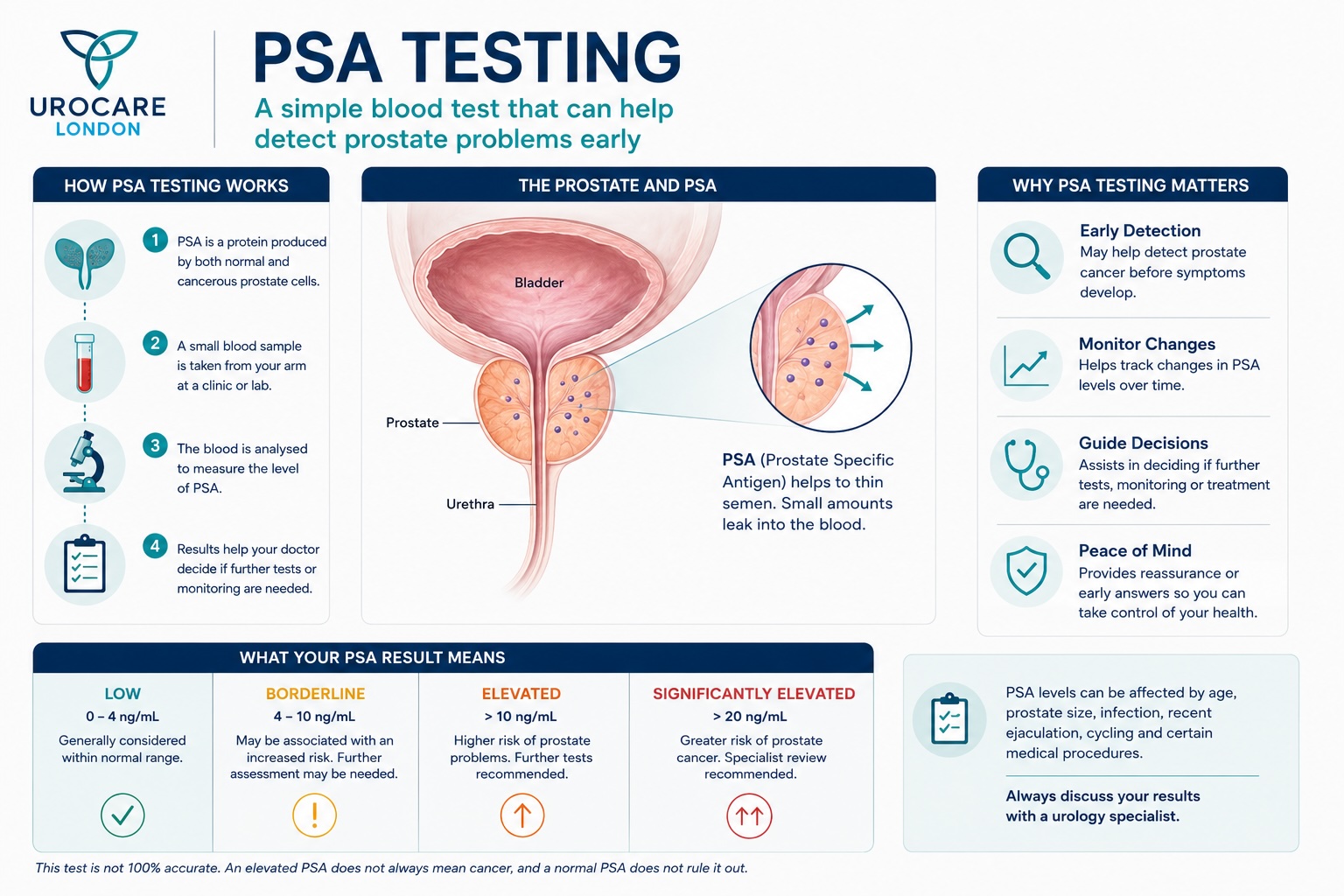
PSA stands for prostate-specific antigen which is a protein produced by the prostate gland. A small amount circulates in the blood and is measured in nanograms per millilitre (ng/mL), and the PSA test is the most widely used screening tool for prostate cancer alongside its role in monitoring benign prostatic hyperplasia (BPH) and prostatitis.
A “private” PSA test simply means the test is arranged through a private clinic rather than via your GP and the NHS – the biochemistry of the test itself is identical. What differs is the speed, the level of Consultant input and what happens next if the result is concerning.
What Is Included In A Private PSA Test At Urocare London?
The outlined fees cover the following:
- A consultation with Mr Maneesh Ghei, Consultant Urological Surgeon, who reviews your medical history, family history, current symptoms and any previous test results before the test itself
- A digital rectal examination (DRE) if clinically indicated, which assesses the size and texture of the prostate
- The PSA blood test, taken on the day in clinic
- A urine analysis to rule out infection (which can falsely raise PSA) and to check for blood
Mr Ghei personally discusses your result – if it is normal you receive reassurance and a recommended retest interval, and if it is raised he explains exactly what that means and walks you through the options before you make any decision.
What Does A Private PSA Test Cost?
| Service | Cost | Includes |
|---|---|---|
| Initial consultation | £250 | 45-minute consultant appointment |
| PSA test plus urine analysis | £296 | Blood draw, lab analysis, results review |
| Multiparametric MRI | From £737 | Only if PSA result requires further investigation |
| Targeted biopsy | Quoted on assessment | Only if MRI identifies a suspicious lesion |
Insurance Patients pay nothing out of pocket where the policy covers prostate screening, and Urocare London accepts Bupa Platinum, AXA Health, Vitality, WPA and Aviva alongside most major insurers.
Private PSA Test London
Book your private PSA test with Mr Maneesh Ghei
£296 for full PSA testing with consultant review and urine analysis. Same-week appointments at The Wellington, King Edward VII’s, Highgate Hospital or HCA Outpatients Elstree. No GP referral required. Both self-funded and insured patients welcome.
Who Should Have A Private PSA Test?
UK guidance from Prostate Cancer UK, BAUS and the latest NICE recommendations points to clear groups who benefit most from PSA testing.
All men aged 50 and over
This is the largest group and the one Jeremy Clarkson sits in. Most early prostate cancer has no symptoms at all and a baseline PSA in your fifties gives your Urologist a personal reference point against which future tests can be tracked – the rate at which PSA rises (its velocity) often matters more than any single number.
Men aged 45 and over with a family history
If your father, brother or son has been diagnosed with prostate cancer, your own lifetime risk is roughly doubled and earlier testing is sensible. A history of breast, ovarian or pancreatic cancer in close female relatives also matters because it raises the chance of a BRCA mutation in the family.
Black men aged 45 and over
Black men have a lifetime risk of prostate cancer of around 1 in 4 compared with 1 in 8 in white men. The UK government has just committed £18 million to extend the TRANSFORM screening trial to all eligible Black men aged 45 to 74, however this is rolling out gradually which means testing privately from age 45 is the most direct route in the meantime.
Men with a known BRCA2 mutation
From June 2026 the NHS is offering targeted PSA screening to men aged 45 to 61 with a confirmed BRCA2 mutation and a family history of prostate, breast, ovarian or pancreatic cancer. If you do not yet have NHS access to this programme or want testing more frequently, private screening fills the gap.
Any man with urinary symptoms
Symptoms that warrant a PSA test at any age include:
- Weak or interrupted urinary stream
- Difficulty starting urination
- Needing to urinate frequently, especially at night
- Urgency or feeling of incomplete emptying
- Blood in the urine or semen
- Pain or discomfort in the pelvic area
Most of these symptoms are caused by benign conditions such as BPH or prostatitis but they should always be investigated.
What Happens At Your Private PSA Test Appointment?
The appointment runs to a simple structure.
- Arrival – you check in at reception at one of 4 hospital locations, with Wellington Hospital in St John’s Wood as the main clinic
- Consultation with Mr Ghei – around 30 to 45 minutes where he reviews your history, family history, any symptoms, current medications and any previous PSA readings
- Digital rectal examination – only performed when clinically indicated, takes a few seconds and gives a hands-on assessment of prostate size and texture
- Blood draw and urine sample – 5 minutes, with samples sent to the hospital lab
- Result and call back – Mr Ghei reviews your result personally and calls you within 2 to 3 working days to walk you through what it means
If your PSA is within your age-adjusted normal range you are reassured and given a recommended retest schedule. If it sits in the grey zone of 4 to 10 ng/mL or above, the next step is usually a multiparametric MRI scan and a biopsy is only considered if the MRI identifies a suspicious lesion.
How To Prepare For Your Private PSA Test
PSA can be temporarily elevated by several common activities. To get the most accurate result, follow these simple rules in the 48 hours before the test:
- Avoid ejaculation for 48 hours
- Avoid vigorous cycling or any activity that puts sustained pressure on the perineum
- Avoid having a digital rectal examination immediately before the blood draw (the order matters)
- Postpone the test if you have an active urinary tract infection
- Mention any prostate biopsy in the past six weeks, as PSA remains elevated for some time after
For a more detailed preparation guide, read our post on PSA blood test preparation.
How Private Compares With The NHS Pathway
| Element | NHS | Private (Urocare London) |
|---|---|---|
| GP referral needed | Yes | No |
| Time to consultation | Weeks to months | Same week |
| PSA result turnaround | 1 to 4 weeks | 2 to 3 working days |
| Time to MRI if needed | Several weeks | 1 to 2 weeks |
| Same consultant throughout | Not guaranteed | Yes, Mr Ghei personally |
| Out of pocket cost | Free (eligibility rules apply) | £296 (PSA pathway), insurance accepted |
How To Book A Private PSA Test In London
Three ways to book at Urocare London:
- Call the practice on 020 3325 4699 for same-week availability and to check if best to book in a test or a consultation initially
- Fill in the contact form on our website
- Book an appointment instantly online using our booking system
Tell the secretary which location works best for you – Wellington Hospital in St John’s Wood, King Edward VII’s in Marylebone, Highgate Hospital in North London or HCA Outpatients in Elstree. If you have insurance have your policy details to hand, and if you are paying out of pocket no payment is required to book.
Frequently Asked Questions
How much does a private PSA test cost in London?
A private PSA test pathway at Urocare London costs £296 which includes a consultation with Mr Maneesh Ghei, the PSA blood test, urine analysis and a personal call-back with your result. If a multiparametric MRI scan is needed afterwards, that is charged separately from £737.
Do I need a GP referral for a private PSA test?
No – Urocare London accepts self-referrals for all private prostate consultations and PSA testing, which means you can book directly by phone, email or online without seeing your GP first.
How long does a private PSA test take?
The blood draw itself takes around 5 minutes and the full consultation, examination and blood test typically take 30 to 45 minutes. Results return within 2 to 3 working days and Mr Ghei calls you personally to discuss them.
Will my private health insurance cover a PSA test?
Most major UK health insurers, including Bupa Platinum, AXA Health, Vitality, WPA and Aviva, cover prostate consultations and PSA testing when clinically indicated. Pre-authorisation rules vary by policy so confirm cover with your insurer before your appointment.
Where in London can I get a private PSA test?
Urocare London offers private PSA testing at 4 locations – The Wellington Hospital (St John’s Wood), King Edward VII’s Hospital (Marylebone), Highgate Hospital (North London) and HCA Outpatients (Elstree) – and the same Consultant, Mr Maneesh Ghei, sees you at each.
How accurate is a PSA blood test?
The PSA test alone is not perfect and it can produce false positives and occasional false negatives. Modern UK best practice combines PSA with multiparametric MRI before any biopsy, which significantly improves accuracy and reduces unnecessary procedures.
Should I have a PSA test if I have no symptoms?
Yes – if you are aged 50 and over, or aged 45 and over with a family history of prostate, breast, ovarian or pancreatic cancer, or if you are Black or carry a BRCA2 mutation. Most early prostate cancers cause no symptoms so waiting until you feel unwell often means catching the disease later than necessary.
Sources
- Prostate Cancer UK: The PSA test – balanced information
- NICE guideline NG131: Prostate cancer diagnosis and management (National Institute for Health and Care Excellence)
- NHS: Prostate cancer diagnosis and PSA testing
- British Association of Urological Surgeons (BAUS): Prostate cancer information
- UK National Screening Committee: Targeted prostate cancer screening recommendation (accepted June 2026)
- Cancer Research UK: Prostate cancer screening
- Imperial College Healthcare NHS Trust: TRANSFORM study extending prostate cancer screening to Black men
About the Author

Mr Maneesh Ghei, Consultant Urological Surgeon (GMC: 5208045)
Mr Maneesh Ghei is a consultant urological surgeon with NHS and private practice across four London hospitals. He specialises in the diagnosis and management of prostate conditions including BPH, prostatitis and prostate cancer, as well as urinary symptoms, kidney stones and male sexual health. Mr Ghei sees new patients privately with same-week availability. Both self-funded and insured patients are welcome. No GP referral is required. Book a prostate screening consultation.