Medically reviewed by Mr Maneesh Ghei, Consultant Urological Surgeon (GMC: 5208045). Last reviewed June 2026.
So is a PSA test considered reliable? A PSA test is the most widely used tool for detecting early prostate cancer, but its reliability is one of the most frequently debated questions in urology. If you have been asked to have one, or you are wondering whether to request one, understanding what the test actually measures and what it cannot tell you is essential for making an informed decision about your health.
Key Takeaways
- PSA (prostate-specific antigen) is a protein produced by the prostate gland. Raised levels can indicate prostate cancer, but also infection, enlargement, and other benign conditions.
- The PSA test is not perfectly reliable in isolation. It produces both false positives and false negatives, but remains the most practical screening tool available.
- PSA velocity (how quickly the level rises over time) is often more informative than a single reading.
- A raised PSA should trigger further investigation, not immediate treatment. Multiparametric MRI is now the recommended next step before any biopsy decision.
- Men over 50, or over 45 with a family history or Black African/Caribbean heritage, should consider routine PSA testing even without symptoms.
Quick Answer
A PSA test is a useful screening tool but not a definitive cancer test. A raised PSA does not confirm cancer, and a normal PSA does not rule it out. Used alongside clinical examination and MRI imaging, it forms an important part of prostate cancer detection.
What does a PSA test actually measure?
PSA stands for prostate-specific antigen, a protein produced almost exclusively by prostate tissue, whether that tissue is normal, enlarged, inflamed, or cancerous. The test measures how much PSA is circulating in your blood, reported in nanograms per millilitre (ng/mL).
A level below 4 ng/mL is generally considered within the normal range for most men, though this threshold shifts with age. A man in his early 50s with a PSA of 3 ng/mL might warrant closer monitoring, while the same level in a 75-year-old with known BPH would be less concerning. PSA results are always interpreted in clinical context, not as a standalone number.
The test itself is straightforward: a blood draw sent to a laboratory. Preparing correctly matters. You should avoid ejaculation, vigorous cycling, and prostate examination for at least 48 hours beforehand, as all of these can temporarily raise PSA levels and produce a misleading result. See our full guide on what not to do before a PSA blood test for the complete preparation checklist.
Why is the PSA test considered unreliable by some?
PSA is not specific to cancer. It is specific to the prostate, which is an important distinction. Almost anything that irritates or enlarges the prostate can raise PSA levels. This leads to two problems.
False positives: A raised PSA where no cancer is present. Around two-thirds of men with a PSA above 4 ng/mL do not have prostate cancer. Their elevated PSA is due to BPH, prostatitis, a recent UTI, or age-related prostate growth. Before the widespread use of MRI, these men often went on to have unnecessary biopsies.
False negatives: A normal PSA where cancer is present. Approximately 15% of men with a PSA below 4 ng/mL do have prostate cancer, often low-grade. This happens because some cancers, particularly small or early ones, do not produce enough PSA to push the level above the threshold.
These limitations are real, and they are why the PSA test has been controversial. The alternative (no screening at all) leads to cancers being found at advanced, harder-to-treat stages. The clinical consensus, reflected in NICE guidelines NG131, is that PSA remains an important tool when used alongside other investigations.
What factors can affect PSA levels besides cancer?
- Benign prostatic hyperplasia (BPH): The most common cause of elevated PSA in men over 50. As the prostate enlarges, it produces more PSA. This is entirely benign but can create confusing test results.
- Prostatitis: Bacterial or inflammatory infection of the prostate can cause a significant, temporary spike in PSA. A repeat test after treatment usually shows the level returning to baseline.
- Urinary tract infection (UTI): Similarly inflames the urinary tract and can raise PSA temporarily.
- Ejaculation: Should be avoided for 48 hours before the test, as it can raise PSA by up to 0.8 ng/mL.
- Vigorous exercise: Particularly cycling, which puts direct pressure on the prostate area.
- 5-alpha reductase inhibitors: Medications used for BPH (such as finasteride and dutasteride) typically halve PSA levels. Clinicians double the measured result to account for this effect. Our guide covers which medications can increase PSA levels in full.
In my clinic, one of the most common situations I see is a man who has had a raised PSA result and has been told it might be cancer, when in fact a recent prostatitis episode or a UTI was the cause. Context matters enormously when reading the number: recent symptoms, medications, activity before the test.
Private Prostate Screening London
Received a raised PSA result and not sure what it means?
A raised PSA does not mean cancer, but it does need proper clinical interpretation. Mr Ghei reviews PSA results in the context of your full clinical picture and arranges any further investigations needed, including MRI. Same-week appointments available. No GP referral required.
What happens if your PSA is raised?
A single raised PSA result does not lead straight to a biopsy in modern urology practice. The pathway is more nuanced than it was a decade ago.
The first step is usually a repeat PSA test four to six weeks later, after eliminating any factors that could have artificially raised the first result. If the repeat result is also elevated, the next step is typically a multiparametric MRI (mpMRI) of the prostate. This imaging study shows the prostate in detail and can identify suspicious areas that may harbour significant cancer.
If the MRI shows a lesion scoring 3 or above on the PIRADS classification, a targeted biopsy guided by the MRI is usually recommended. If the MRI is reassuring, active surveillance or a repeat PSA in 12 months may be more appropriate. Many men with mildly raised PSA can avoid a biopsy altogether with this approach, which is now standard of care.
Not all prostate cancers detected through PSA screening require treatment. Low-risk cancers (slow-growing, small, confined to the prostate) are frequently managed with active surveillance: regular PSA monitoring, MRI, and periodic biopsy to watch for progression.
How does PSA velocity improve accuracy?
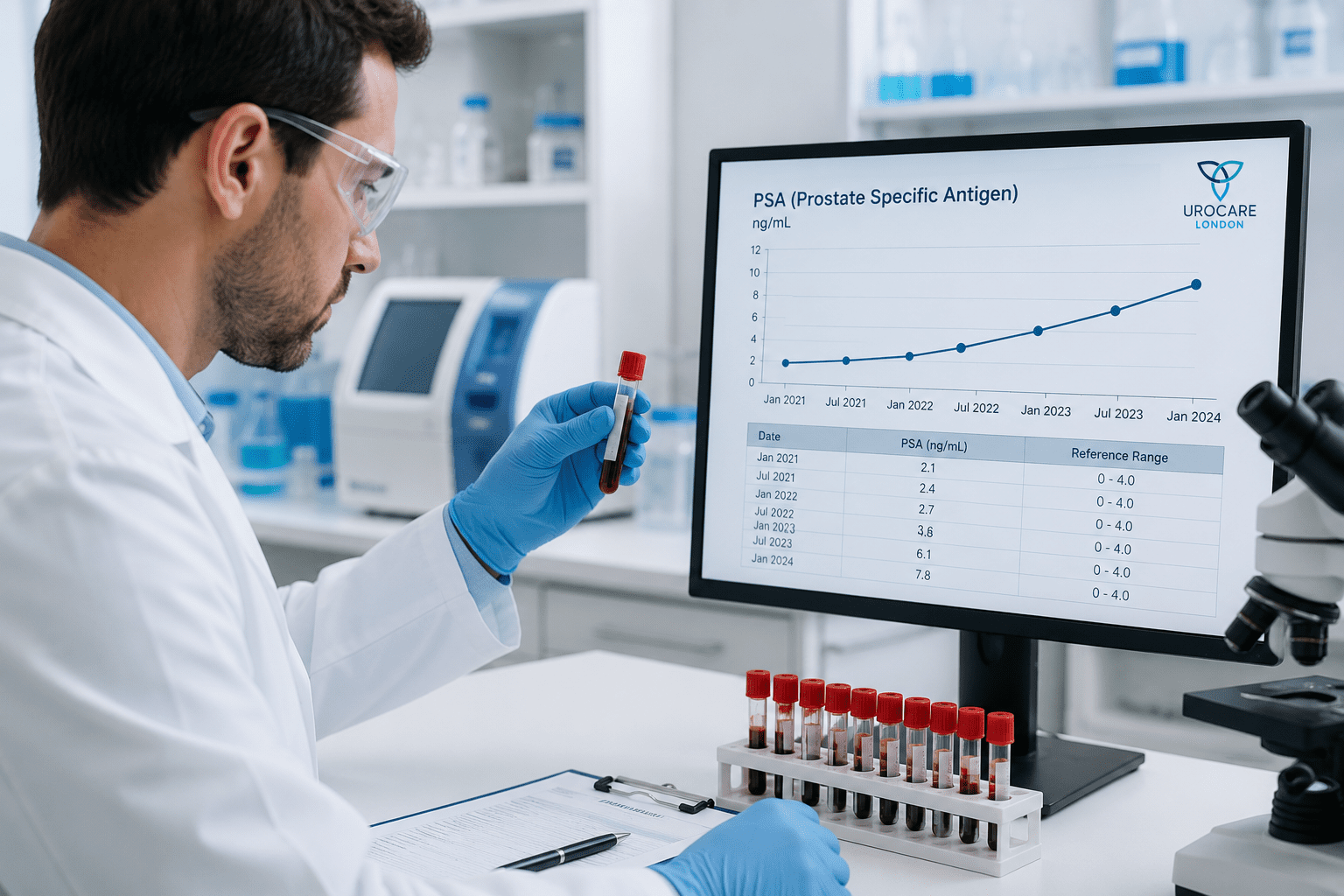
PSA velocity refers to how quickly your PSA level is rising over time. A man whose PSA goes from 2.5 to 4.5 ng/mL over 12 months raises different concern than one whose level has been stable at 4 ng/mL for five years, even if they have the same reading at any given moment.
A rise of more than 0.75 ng/mL per year is generally considered clinically significant and warrants investigation, regardless of the absolute level. Establishing a baseline PSA and repeating it regularly gives far more useful information than a single one-off test.
Who should have a PSA test?
The NHS does not currently operate a national prostate cancer screening programme, but any man over 50 can request a PSA test from his GP. Men who should seriously consider PSA testing:
- Age 50 or over with no symptoms but wanting a baseline assessment
- Age 45 or over with a first-degree relative (father, brother) diagnosed with prostate cancer — read our guide on whether prostate cancer is hereditary if family history applies to you
- Black African or Black Caribbean men from age 45
- Men of any age with a known BRCA2 mutation
- Men with urinary symptoms present for more than a few weeks
Frequently Asked Questions
Is a PSA test accurate enough to diagnose prostate cancer?
No. PSA alone cannot diagnose prostate cancer. It can indicate that further investigation is needed, but diagnosis requires tissue analysis via biopsy. The PSA test is best understood as a triage tool that directs attention toward the prostate, not as a definitive cancer test.
What PSA level is considered dangerous?
There is no single threshold that confirms cancer. A PSA above 10 ng/mL carries a higher probability of prostate cancer: around 50% of men with this level will have cancer on biopsy. PSA between 4 and 10 ng/mL is the grey zone where clinical context, MRI, and PSA velocity guide next steps. Even a PSA above 4 ng/mL is more likely due to benign causes than cancer in most cases.
How often should you have a PSA test?
If your PSA is normal and you have no symptoms, most urologists suggest retesting every one to two years from age 50 (or 45 if you are at higher risk). The value of PSA testing comes largely from tracking trends over time, which is why a single baseline reading is far less useful than a series of results.
Can a PSA test miss prostate cancer?
Yes. Around 15% of prostate cancers occur in men with PSA below 4 ng/mL. A normal PSA result in a man with urinary symptoms or strong risk factors does not necessarily mean the prostate is healthy. Clinical judgement is still required.
Does a high PSA mean I need a biopsy straight away?
Not necessarily. Current best practice, as recommended by NICE, is to perform a multiparametric MRI of the prostate before deciding on biopsy. If the MRI is reassuring, a biopsy may not be required. This approach reduces unnecessary procedures while still identifying clinically significant cancers.
What should I avoid before a PSA blood test?
Avoid ejaculation for 48 hours before the test. Avoid vigorous cycling or exercise that puts pressure on the perineal area. Tell your doctor if you have had a prostate examination, urinary catheter, or prostate procedure within the previous week, or if you are on medication for prostate enlargement, as all of these can affect the result.
Can the PSA test be used to monitor prostate cancer after treatment?
Yes. PSA monitoring is central to post-treatment follow-up for prostate cancer. After radical prostatectomy, PSA should become undetectable. After radiotherapy, it typically falls gradually over several months. A rising PSA after treatment (known as biochemical recurrence) can be an early sign of cancer returning, often detectable before any symptoms develop.
Is there a more accurate test than PSA for prostate cancer?
Several newer tests aim to improve on PSA accuracy, including the Prostate Health Index (PHI), the 4Kscore, and Select MDx urine testing. These are increasingly available in private urology practice and can help refine risk estimates for men in the grey zone. They are used alongside PSA rather than as replacements, and mpMRI remains the most clinically significant advance in reducing unnecessary biopsies.
Sources
- NHS: Diagnosing prostate cancer
- NICE guideline NG131: Prostate cancer diagnosis and management
- BAUS: Prostate cancer patient information
- Cancer Research UK: PSA test
This article is for information only and is not a substitute for personalised medical advice. If you have concerns about your PSA results or prostate health, speak to your GP or a consultant urologist.
About the Author

Mr Maneesh Ghei, Consultant Urological Surgeon (GMC: 5208045)
Mr Maneesh Ghei is a consultant urological surgeon with NHS and private practice across four London hospitals. He specialises in the diagnosis and management of prostate conditions including BPH, prostatitis and prostate cancer, as well as urinary symptoms, kidney stones and male sexual health. Mr Ghei sees new patients privately with same-week availability. No GP referral is required. Book a prostate screening consultation.