
Medically reviewed by Mr Maneesh Ghei, Consultant Urological Surgeon (GMC: 5208045)
A dangerous PSA level is generally considered to be above 10 ng/mL, at which point the likelihood of prostate cancer is significantly raised and urgent specialist investigation is needed. PSA between 4 ng/mL and 10 ng/mL falls into a grey zone requiring careful interpretation, and a rapid rise of more than 0.75 ng/mL per year can be just as concerning as any single high reading.
There is no single universal threshold that applies to every man. Age, ethnicity, personal baseline and the rate at which your PSA is changing all affect what a result means for you.
Key Takeaways
- A PSA above 10 ng/mL significantly increases the likelihood of prostate cancer and requires specialist review
- PSA velocity - how fast your level is rising - can matter more than the absolute number
- High PSA does not automatically mean cancer; BPH and prostatitis also raise PSA
- Age-adjusted normal ranges mean a reading acceptable at 70 may be concerning at 50
- Private PSA testing is available in London without a GP referral, with same-week appointments
Worried about what your PSA result means? Book a private consultation with Mr Maneesh Ghei - same-week appointments, no GP referral needed.
What Are PSA Levels?
PSA, or prostate-specific antigen, is a protein produced by the prostate gland. It circulates in the blood and is measured in nanograms per millilitre (ng/mL). A PSA blood test is the primary screening tool for prostate conditions including prostate cancer, benign prostatic hyperplasia (BPH) and prostatitis.
PSA is not exclusive to cancer. The prostate naturally produces PSA throughout a man’s life, and levels tend to rise with age. What matters is whether your level is appropriate for your age and whether it is changing over time.
Age-adjusted PSA reference ranges
| Age | Normal PSA Range |
|---|---|
| 40-49 | Below 2.5 ng/mL |
| 50-59 | Below 3.5 ng/mL |
| 60-69 | Below 4.5 ng/mL |
| 70 and over | Below 6.5 ng/mL |
These ranges are a guide. Some men naturally have higher baseline PSA due to a larger prostate, African Caribbean ethnicity or a family history of prostate cancer - all of which warrant a lower threshold for concern.
What Is A Dangerous PSA Level?
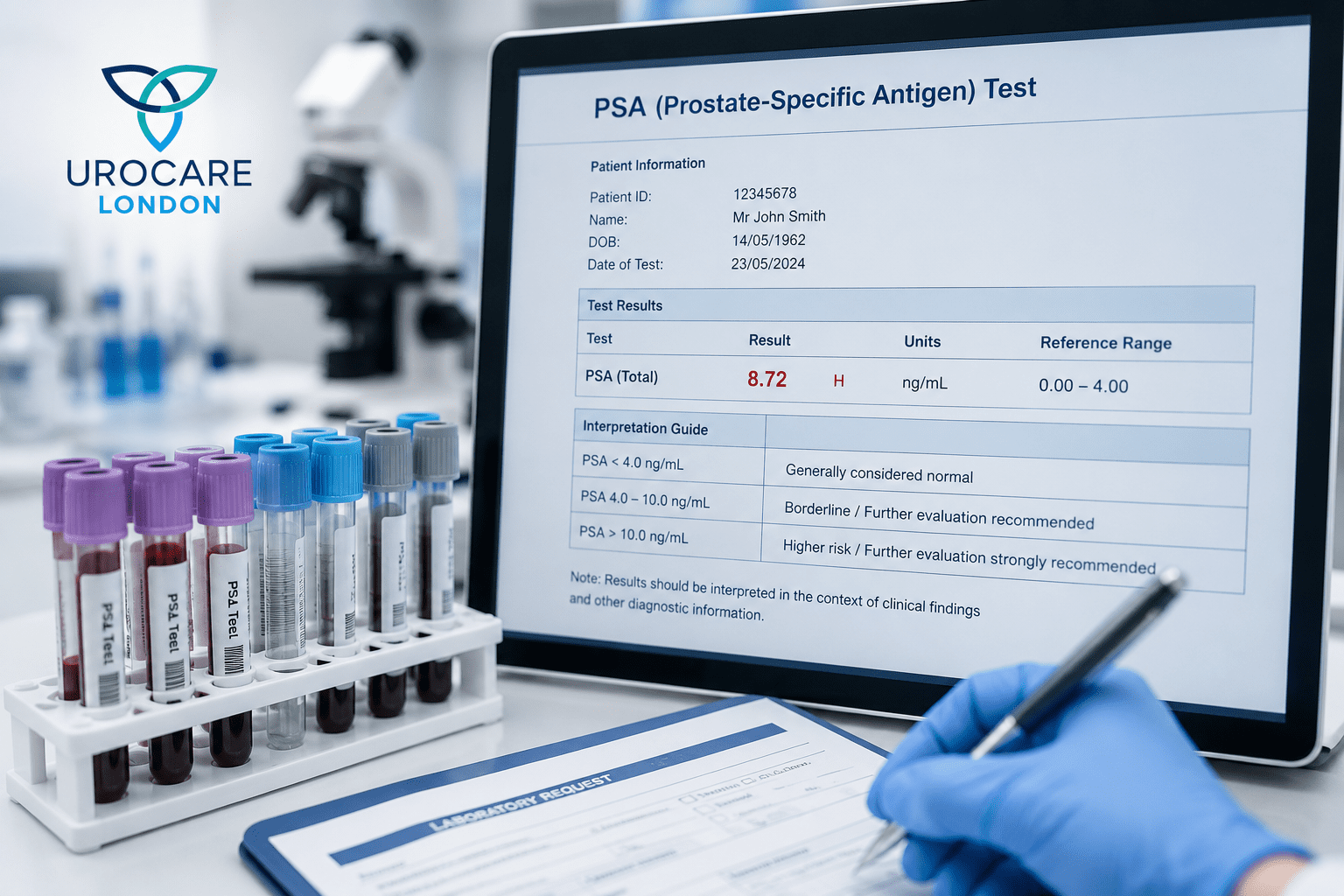
Understanding what constitutes a dangerous PSA level requires looking at three factors together: the absolute number, the rate of change and the free-to-total PSA ratio.
PSA above 10 ng/mL
A PSA reading above 10 ng/mL is considered high risk. According to BAUS guidance, levels in this range are associated with a greater than 50% probability of prostate cancer being present. This level requires prompt investigation and should not be left unaddressed.
PSA velocity - the rate of rise
PSA velocity refers to how quickly your PSA level is rising over time. A rise exceeding 0.75 ng/mL per year is clinically significant - even if the total PSA remains within what appears to be a normal range. A rapidly rising PSA can indicate aggressive cancer and warrants the same urgency as a high absolute reading.
Free-to-total PSA ratio
PSA exists in the blood in two forms: free PSA (unbound) and PSA bound to proteins. A free-to-total PSA ratio below 25% indicates a higher probability of prostate cancer versus benign conditions. Your urologist will use this ratio alongside the total PSA to refine the assessment.
What Else Can Cause High PSA Levels?
A raised PSA does not automatically mean prostate cancer is present. Several non-cancerous conditions and activities can elevate PSA temporarily or persistently:
- Benign prostatic hyperplasia (BPH) - an enlarged prostate is one of the most common causes of raised PSA in men over 50
- Prostatitis - inflammation of the prostate, which can cause a sudden sharp spike in PSA
- Urinary tract infection - active infection can transiently raise PSA
- Recent ejaculation - PSA can be temporarily elevated for 24-48 hours
- Digital rectal examination (DRE) - physical examination of the prostate can briefly elevate readings
- Prostate biopsy or surgery - these cause significant but temporary PSA elevation and testing should be deferred for several weeks afterwards
This is why a single PSA reading is rarely interpreted in isolation. Context, history and repeat testing all form part of the picture.
How Is Prostate Cancer Diagnosed Beyond PSA?
If your PSA level raises concern, your urologist will recommend further investigations. These may include:
- Digital rectal examination (DRE) - a brief physical examination to assess the size, shape and texture of the prostate
- Multiparametric MRI (mpMRI) - an imaging scan that produces detailed pictures of the prostate to identify any suspicious areas before biopsy is considered
- Prostate biopsy - a tissue sample taken under local anaesthetic if imaging identifies areas that need closer examination
Private investigation pathways in London move considerably faster than NHS waiting times. A private mpMRI can typically be arranged within one to two weeks, with results and a management plan discussed shortly after.
What Should You Do If You Have A High PSA Level?
If a GP or private test has returned a raised PSA, the most important step is to have it reviewed by a urologist - not a GP - who can interpret the result in full clinical context. A urologist will assess your PSA velocity, your age-adjusted range, your symptoms and your personal and family history before recommending next steps.
In many cases, a raised PSA will not lead to a cancer diagnosis. However, in those cases where it does, early detection significantly improves outcomes. Private prostate cancer screening in London is available without a GP referral and with same-week appointments.
Private Prostate Screening London
Concerned about your PSA result? Get a specialist opinion this week.
Mr Maneesh Ghei, Consultant Urological Surgeon, offers private prostate consultations across four London locations. A raised PSA is not a diagnosis - but it does need specialist interpretation. No GP referral required. Initial consultation from £250.
Frequently Asked Questions
What is a dangerous PSA level?
A PSA level above 10 ng/mL is considered high risk and warrants urgent investigation by a urologist. PSA between 4 and 10 ng/mL falls into a grey zone that requires contextual interpretation. A rise of more than 0.75 ng/mL per year is clinically significant regardless of the absolute number.
What PSA level is too high for your age?
Age-adjusted PSA ranges are: below 2.5 ng/mL for men aged 40-49; below 3.5 ng/mL for ages 50-59; below 4.5 ng/mL for ages 60-69; below 6.5 ng/mL for men over 70. A reading above the threshold for your age group warrants specialist review.
Does a high PSA always mean prostate cancer?
No. Benign prostatic hyperplasia (BPH), prostatitis, urinary tract infections, recent ejaculation and digital rectal examination can all raise PSA levels without cancer being present. A high PSA is a reason to investigate further, not a diagnosis in itself.
How quickly can PSA levels rise?
PSA velocity above 0.75 ng/mL per year is considered clinically significant. A rapid rise, even if the total PSA remains within normal age-adjusted ranges, can indicate aggressive prostate cancer and should be assessed by a specialist without delay.
Can I get a private PSA test without a GP referral?
Yes. Mr Maneesh Ghei at Urocare London accepts self-referrals for private PSA testing and prostate consultations. Results are typically available within 2-3 working days and same-week appointments are available in London.
What happens after a high PSA result?
Your urologist will assess your PSA in the context of your age, symptoms, personal baseline and velocity. Next steps may include a repeat PSA test, a multiparametric MRI scan or a prostate biopsy. Not all elevated PSA readings require a biopsy.
Where can I see a private prostate specialist in London?
Mr Maneesh Ghei is a Consultant Urological Surgeon at Urocare London, based at The Wellington Hospital in St John’s Wood. Same-week private prostate consultations are available with no GP referral required. Call 020 3325 4699 or book online.
About the Author

Mr Maneesh Ghei, Consultant Urological Surgeon (GMC: 5208045)
Mr Maneesh Ghei is a consultant urological surgeon with NHS and private practice across four London hospitals. He specialises in the diagnosis and management of prostate conditions including BPH, prostatitis and prostate cancer, as well as urinary symptoms, kidney stones and male sexual health. Mr Ghei sees new patients privately with same-week availability. No GP referral is required. Book a prostate screening consultation.