
Medically reviewed by Mr Maneesh Ghei, Consultant Urological Surgeon (GMC: 5208045)
If you’re looking for a blood in urine specialist in London, the specialty you want is urology and the assessment is usually straightforward.
Visible blood in the urine needs investigating in every adult and NICE recommends urgent investigation in anyone aged 45 and over even where there’s no pain alongside. The standard assessment is a urine test, imaging of the kidneys and a camera look at the bladder, which can often be arranged within the same week privately rather than being on a longer NHS waiting list.
Key Takeaways
- Visible blood in the urine should always be investigated, even if it only happened once.
- Painless blood is more concerning than painful blood, not less.
- The assessment is usually a urine test, a scan of the kidneys and a flexible cystoscopy.
- Most causes turn out to be benign, however, the point of the assessment is to prove that rather than assume it.
- An initial consultation with Mr Ghei is £250 and tests are clearly quoted before being arranged.

Blood in the urine is one of those symptoms people are tempted to wait out, particularly when it happens once and then stops.
“I often hear from men that it only happened once so they assumed it had sorted itself out however, bleeding from the urinary tract is frequently intermittent.
In most men I assess the cause turns out to be benign and I can say so by the end of the appointment - that reassurance is worth having properly rather than just hoping things have resolved”
- Mr Maneesh Ghei, Consultant Urological Surgeon
Visible and non-visible blood
Visible haematuria is blood you can see so urine that’s pink, red or the colour of tea or cola. It needs investigating in every adult and NICE recommends it’s done urgently from age 45.
Non-visible haematuria is blood picked up on a dipstick at a routine check with nothing visible in the toilet. It’s far more common and far less often serious, though it still warrants assessment, particularly alongside any urinary symptoms. Our post on haemolysed versus non-haemolysed blood in urine explains what the dipstick result is actually telling you.
One thing worth knowing. Painless bleeding is the pattern that needs attention most. Pain usually means infection or a stone, both of which have obvious explanations, whereas painless visible bleeding is the classic presentation of a bladder problem and that’s the one not to sit on.
What causes it
In rough order of how often they turn up:
- Urinary infection - the most common cause by a distance, usually with stinging and urgency alongside. See whether a UTI can cause blood in urine
- Kidney or bladder stones - usually painful
- An enlarged prostate - benign enlargement can bleed, particularly with straining
- Vigorous exercise - long distance running can produce transient blood
- Kidney conditions - inflammation of the filtering units, usually non-visible and picked up on testing
- Bladder or kidney cancer - the least common of these and the one the assessment is designed to rule out
- Sexually transmitted infection - see which STIs cause blood in urine
Blood after prostate surgery is a separate situation with its own expected timeline, covered in how long there should be blood in urine after prostate surgery.
Private Haematuria Assessment London
Seen blood once? That's enough reason to get it checked
Bleeding from the urinary tract is often intermittent so waiting to see if it happens again isn't a useful test. An initial consultation with Mr Ghei is £250 and the investigations are usually arranged within the same week. No GP referral needed to self-pay.
Or call us on 020 3325 4699 (Mon to Fri, answered personally)
What the assessment involves
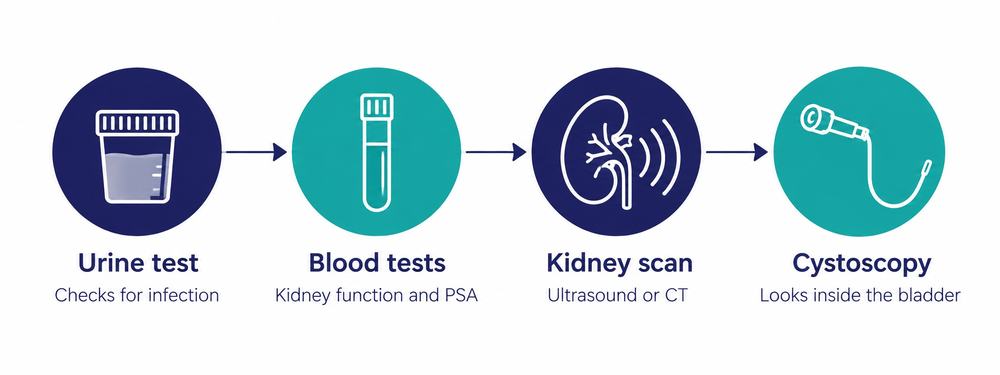
A haematuria assessment is a defined set of tests rather than an open-ended investigation, which is why it can be done quickly.
Urine tests
A sample is sent for culture to confirm or exclude infection and in some cases for cytology, which looks for abnormal cells. Infection is the most common cause so this is where it starts.
Blood tests
Kidney function, a full blood count and a PSA in men, since an enlarged prostate is a recognised cause.
Imaging of the kidneys
Usually an ultrasound or a CT urogram where the picture needs to be more detailed. This looks at the kidneys and the drainage system, the part a camera can’t reach.
Flexible cystoscopy
A thin camera passed into the bladder under local anaesthetic, taking around 5 minutes. It’s the only way to see the bladder lining directly and scans alone can miss small or flat areas. There’s more on what it involves and what it costs in our guide to private cystoscopy cost.
Not every patient needs all 4. A young woman with blood and clear infection symptoms is a different proposition from a 60 year old man with painless visible bleeding and the assessment is scaled to the situation.
What it costs privately
An initial consultation with Mr Ghei is £250. Tests and scans are hospital fees charged separately where required and each one is quoted before it’s arranged so you make an informed decision.
Insurance generally covers investigation of haematuria because it’s a clear clinical indication. Mr Ghei is recognised by all major UK insurers and is BUPA platinum recognised. Pre-authorisation is arranged before your appointment. It is important to check your excess and whether your policy needs a GP referral. Full fees are on the fees and insurance page.
Private versus the NHS route
Visible haematuria in anyone aged 45 and over should go down the urgent suspected cancer pathway on the NHS, which is designed to move quickly and if your GP has referred you that way. The NICE guideline NG12 on suspected cancer recognition and referral sets out the criteria.
Where going private genuinely helps is the situation that doesn’t meet those criteria, for example - non-visible blood found on a routine dipstick, a single episode in someone under 45 or bleeding that’s been put down to infection twice and keeps returning. These sorts of issues can be checked for peace of mind privately and within a short period of time so you don’t have to sit on a waiting list.
If the blood has stopped
Get it checked anyway.
Urinary tract bleeding comes and goes so a clear sample today says nothing about what was happening last week. Bring the detail with you - when it happened, what colour it was, whether there was pain and whether there were clots - this is all useful information.
Where you’d be seen in London
A haematuria assessment can usually be started at whichever of our 4 private hospitals is easiest for you to reach:
- The Wellington Hospital, Platinum Medical Centre, 15-17 Lodge Road, St John’s Wood, London NW8 7JA
- King Edward VII’s Hospital, Beaumont Street, Marylebone, London W1G
- Highgate Hospital, 17-19 View Road, Highgate, London N6 4DJ
- HCA Outpatients and Diagnostics, Beaufort House, Elstree Waterfront, Hertfordshire WD6 3BS
Because the tests are a defined set rather than an open-ended investigation, most of it can often be completed within the same week. Clinic days and times do vary so it is worth calling 020 3325 4699 to check before you travel.
Frequently Asked Questions
Should I see a specialist for blood in my urine?
Yes. Visible blood in the urine should be investigated in every adult and NICE recommends urgent investigation from age 45, even where there’s no pain. Non-visible blood found on a dipstick also warrants assessment, particularly alongside urinary symptoms.
What tests are done for blood in the urine?
Usually a urine sample for infection and sometimes cytology, blood tests including kidney function and PSA in men, imaging of the kidneys by ultrasound or CT and a flexible cystoscopy to look at the bladder lining directly. Not everyone needs all 4.
Does blood in urine always mean cancer?
No. Infection is by far the most common cause, followed by stones and benign prostate enlargement. Cancer is one of the less common causes and ruling it out is the main reason the assessment is done.
How much does a private haematuria assessment cost?
An initial consultation with Mr Ghei is £250 and tests are charged separately as hospital fees. Each test is quoted before it’s arranged so you’ll know the cost of each step before agreeing to it.
What if the blood has stopped?
You should still be assessed. Bleeding from the urinary tract is often intermittent so a single episode followed by nothing doesn’t rule anything out. Bring details of when it happened, the colour and whether there was any pain.
Where in London can I be assessed for blood in my urine?
We hold clinics at The Wellington Hospital in St John’s Wood NW8, King Edward VII’s Hospital in Marylebone W1G, Highgate Hospital in N6 and HCA Elstree in Hertfordshire WD6. An assessment can usually be started at whichever is easiest for you to reach, often within the same week.
About the Author

Mr Maneesh Ghei MS MRCSEd MD (UCL) FRCS (Urol)Consultant Urological Surgeon · GMC 5208045
Founder of Urocare London, with over 3 decades of practice across NHS and private settings in the capital. He is Lead Cancer Clinician at Whittington Hospital, Archway, where he chairs the multidisciplinary urology cancer meeting.
A specialist in complex endourology and stone disease, Mr Ghei led the UK’s first randomised double-blind trial of intradetrusor botulinum toxin for refractory overactive bladder. He holds an MBBS and MS in General Surgery, an MD from University College London and a Fellowship of the Royal College of Surgeons (Urology).
He sees new patients privately with same-week availability and no GP referral is needed. Book a consultation or request a callback.