Medically reviewed by Mr Maneesh Ghei, Consultant Urological Surgeon (GMC: 5208045). Last reviewed: 4 July 2026.
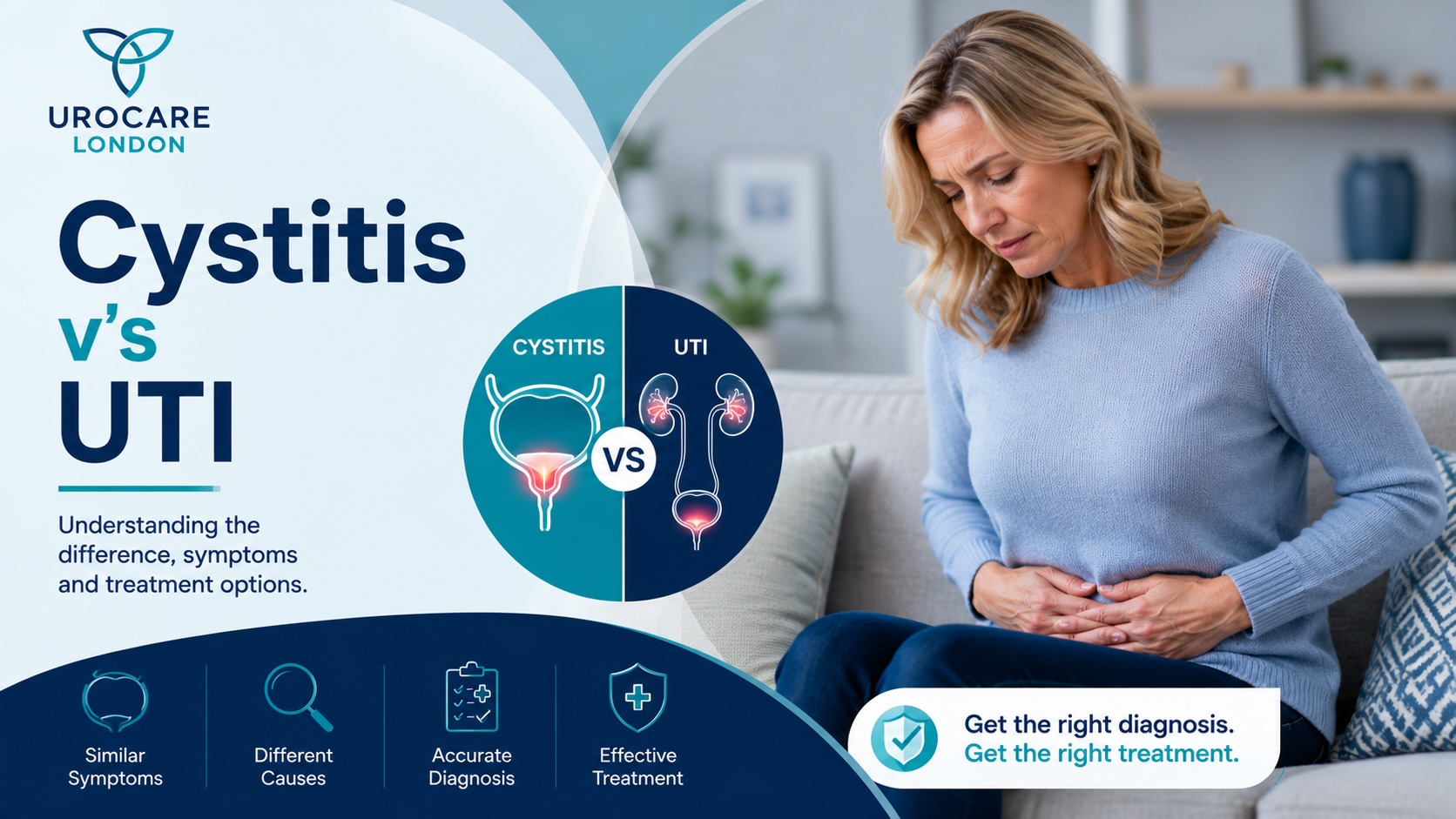
The difference between cystitis and a UTI comes down to location. A UTI (urinary tract infection) is the umbrella term for an infection anywhere in the urinary system: the kidneys, ureters, bladder or urethra. Cystitis means inflammation of the bladder specifically, and in most cases it is caused by infection. So bacterial cystitis is a UTI, but not every UTI is cystitis. An infection in the kidneys or urethra is still a UTI, just not a bladder one.
Patients often arrive at my clinic worried they have been given two different diagnoses. In practice, the two terms usually describe the same episode from different angles: one names the infection, the other names where it is.
Quick Answer
Cystitis is inflammation of the bladder, most often caused by a bacterial infection. A UTI is any infection in the urinary tract, including the bladder, kidneys or urethra. Bacterial cystitis is the most common type of UTI, so the two terms often describe the same illness.
Key Takeaways
- UTI is the umbrella term. Cystitis is a bladder infection, the most common type of UTI
- Cystitis can occasionally occur without infection, for example interstitial cystitis or irritation from products and radiotherapy
- Fever, back or flank pain, vomiting or confusion suggest the infection has reached the kidneys and needs same-day medical attention
- UTIs in men are less common and always worth investigating, as they often point to an underlying cause such as prostate enlargement
- Recurrent cystitis (three or more episodes a year) warrants specialist assessment, not just repeat antibiotics
What is the difference between cystitis and a UTI?
A urinary tract infection can occur anywhere along the urinary system. Doctors divide UTIs by location:
- Cystitis: infection or inflammation of the bladder. This is by far the most common form
- Urethritis: inflammation of the urethra, the tube that carries urine out of the body
- Pyelonephritis: a kidney infection, the most serious form of UTI
A common misconception is that cystitis and a UTI are two separate conditions, and that one is milder than the other. In practice, bacterial cystitis is a UTI. If bacteria have infected your bladder, both labels apply to you at the same time. The distinction only matters when the infection is somewhere other than the bladder, or when the bladder is inflamed without any infection at all.
Most UTIs start when bacteria from the bowel, usually E. coli, enter the urethra and travel up into the bladder. E. coli is responsible for the majority of uncomplicated UTIs. Women are affected far more often than men because the female urethra is shorter and sits closer to the back passage, giving bacteria a shorter distance to travel. Around half of all women will have at least one UTI in their lifetime.
What is cystitis?
Cystitis means inflammation of the bladder lining. The name comes from “cyst”, referring to the bladder, and “itis”, meaning inflammation. What matters clinically is what is causing that inflammation.
Bacterial cystitis
The overwhelming majority of cystitis cases are bacterial. Bacteria multiply in the bladder, the lining becomes inflamed and the familiar symptoms follow: burning, urgency and frequency. This is the version most people mean when they say they have cystitis, and it is what a GP or pharmacist is treating when they prescribe a short course of antibiotics.
Non-infectious and interstitial cystitis
The bladder can also become inflamed without any infection. Triggers include irritation from spermicides or hygiene products, some medications, radiotherapy to the pelvis and a chronic condition called interstitial cystitis (also known as bladder pain syndrome). This distinction matters because antibiotics do nothing for non-infectious cystitis. If your urine cultures keep coming back clear yet your symptoms persist, this is one of the possibilities a urologist will consider. I see this pattern regularly: patients who have had several courses of antibiotics with no improvement, where the real issue was never infection in the first place. Our post on what can be mistaken for a urinary tract infection covers the other conditions that mimic UTI symptoms.
What are the symptoms of cystitis?
Cystitis symptoms usually develop quickly, often over a day or two:
- A frequent, urgent need to urinate, even when the bladder is nearly empty
- Burning or stinging when passing urine (doctors call this dysuria)
- Bladder pain or a dragging discomfort low in the abdomen
- Cloudy, dark or strong-smelling urine
- Blood in your urine, which may look pink, red or cola-coloured
- Feeling generally tired or run down
One point I stress to every patient: visible blood in the urine should always be checked, even if it appears during what feels like a routine bout of cystitis and even if it settles once the infection clears. Infection is the most common cause, but blood in the urine occasionally signals something more serious and it needs to be confirmed as gone once treatment finishes.
How do symptoms differ when a UTI reaches the kidneys?
Where the infection sits changes both the symptoms and the urgency. This table summarises the differences:
| Type of UTI | Location | Typical symptoms | Urgency |
|---|---|---|---|
| Cystitis | Bladder | Burning, frequency, urgency, lower abdominal discomfort | See a pharmacist or GP; often settles quickly with treatment |
| Urethritis | Urethra | Burning on urination, discharge, less frequency or urgency | GP or sexual health clinic; STI testing often needed |
| Pyelonephritis (kidney infection) | Kidneys | Fever, chills, kidney pain in the back or side, nausea, vomiting, confusion in older adults | Same-day medical attention, sometimes hospital admission |
Location is also the main clue during assessment. Pain or pressure low in the abdomen points to the bladder. Pain in the back or side, particularly with fever, points to the kidneys. An untreated bladder infection can climb to the kidneys, which is why symptoms that worsen or spread should never be waited out. Our post on how long a UTI lasts if untreated explains that progression in detail.
When To Seek Urgent Help
Go to A&E or call 999 if you have UTI symptoms together with any of the following: a very high or very low temperature, shaking chills, drowsiness or confusion, breathing fast or not passing urine all day. These can be signs of sepsis, which is a medical emergency.
Seek same-day help from your GP or NHS 111 if you have a fever with pain in your back or side, you are vomiting, your symptoms have not improved after 48 hours of antibiotics or you are pregnant with UTI symptoms.
Are cystitis and UTIs different in men?
Yes, and the difference is significant. UTIs are far less common in men because the male urethra is longer, so a confirmed infection in a man is never dismissed as routine. In men, a UTI often has an underlying cause: an enlarged prostate obstructing the bladder, incomplete bladder emptying, a stone or, rarely, something more serious. That is why guidelines recommend men are investigated rather than simply given repeat antibiotics.
Men also get prostatitis, an infection or inflammation of the prostate that can feel similar to cystitis but needs longer treatment. If you are a man with burning, frequency or pelvic discomfort, read our post on how a man gets a urinary tract infection, and take the symptoms seriously even if they are mild. Most of the men I see with recurrent infections turn out to have a treatable underlying cause, and treating that cause is what stops the infections coming back.
Why do I keep getting cystitis?
Recurrent UTI is usually defined as three or more infections in a year, or two within six months. If this is you, the priority is finding out why rather than reaching for another antibiotic course each time.
Common reasons include incomplete bladder emptying, hormonal changes after menopause, bladder or kidney stones and, in men, an enlarged prostate. Sometimes what feels like recurrent infection is actually one infection that was never fully cleared, and sometimes it is not infection at all. Our posts on why UTI symptoms come and go and the warning signs of a bladder infection are useful reading if you are stuck in this cycle.
For recurrent cases we would typically discuss a tailored plan: urine cultures timed correctly, imaging of the kidneys and bladder if indicated, a bladder inspection where the history suggests it and preventive options ranging from behavioural measures to low-dose antibiotic prophylaxis or topical oestrogen after menopause. Both approaches are reasonable in different situations, and the choice depends on your history and your preference.
Private Urology Consultation London
Cystitis that keeps coming back, or symptoms that will not settle?
Mr Maneesh Ghei sees patients with recurrent cystitis, persistent UTI symptoms and blood in the urine at The Wellington Hospital, St John’s Wood. Same-week appointments, no GP referral needed. Both self-funded and insured patients are welcome.
How are cystitis and other UTIs diagnosed?
For a first, straightforward episode, diagnosis is usually clinical: your symptoms plus a urine dipstick test looking for white blood cells, nitrites and blood. A dipstick takes minutes and is often all that is needed before starting treatment.
Where the picture is less clear, a midstream urine sample is sent to the laboratory for culture. This identifies the exact bacteria and which antibiotics will work against it, which matters when a first course has failed or infections keep recurring. What I explain to patients at this point is that the timing of the sample makes a real difference: a culture taken after antibiotics have started will often come back falsely clear.
For recurrent or complicated cases, we look deeper. An ultrasound or CT scan checks the kidneys and bladder for stones, obstruction or incomplete emptying, and a cystoscopy lets us inspect the bladder lining directly using a fine camera. A cystoscopy takes around 15 to 20 minutes under local anaesthetic and most patients find it uncomfortable rather than painful.
How are cystitis and UTIs treated?
Bacterial cystitis responds well to a short course of antibiotics. For uncomplicated cystitis in women, NICE recommends a three-day course, most commonly nitrofurantoin or trimethoprim. Many mild episodes will also settle on their own within a few days with fluids and simple painkillers, which is why a pharmacist may suggest self-care first for mild symptoms.
Men are treated for at least seven days, reflecting the higher chance of prostate involvement. Kidney infections need longer courses, usually 7 to 14 days, and severe cases are admitted to hospital for intravenous antibiotics. In straightforward cases I would usually start conservatively and reserve investigation for infections that recur or fail to clear.
For non-infectious cystitis, antibiotics have no role. Treatment focuses on identifying and removing the trigger, managing symptoms and, in interstitial cystitis, a stepwise plan that can include bladder retraining, medication and specialist bladder treatments.
When should I see a doctor about cystitis or UTI symptoms?
See a pharmacist or GP for a first episode of mild cystitis. Beyond that, arrange a proper review if any of the following apply:
- You are a man with UTI symptoms, even mild ones
- You have had three or more infections in a year, or two in six months
- You have seen blood in your urine, even once, even if it settled
- Symptoms persist despite antibiotics, or cultures keep coming back clear
- You have fever with back or side pain (this needs same-day attention)
Patients attending our London clinic are usually seen within the week. A private assessment includes a consultation with a consultant urological surgeon, urine testing and any imaging or bladder inspection arranged promptly, typically within days rather than the weeks a routine NHS referral can take. No GP referral is required.
How can I prevent cystitis and UTIs?
The evidence-based measures are simpler than the internet suggests. Drink enough fluid to keep urine pale, do not hold on when you need to pass urine, wipe from front to back and urinate soon after sex. Avoiding spermicides and heavily perfumed products around the genital area helps some people with irritation-driven symptoms.
Cranberry products are popular, and the honest answer is that the evidence is mixed: some studies show a modest benefit for prevention in women with recurrent infections, others show none. They are reasonable to try and unlikely to cause harm, but they are not a treatment for an active infection. For genuinely recurrent infections, the preventive options with the strongest evidence are the medical ones discussed at specialist review.
Frequently Asked Questions
Is cystitis the same as a UTI?
Not exactly. A UTI is an infection anywhere in the urinary tract, while cystitis refers specifically to inflammation of the bladder. Bacterial cystitis is the most common type of UTI, so the two terms often describe the same illness, but a kidney or urethral infection is a UTI without being cystitis.
Can you have cystitis without an infection?
Yes. The bladder lining can become inflamed by irritants such as spermicides or hygiene products, by some medications, by radiotherapy to the pelvis or by interstitial cystitis, a chronic bladder pain condition. Antibiotics do not help these cases, which is why persistent symptoms with clear urine cultures need specialist assessment.
How do I know if my UTI has spread to my kidneys?
The warning signs are fever, shivering or chills, pain in your back or side, nausea or vomiting and feeling generally very unwell. Confusion can be the main sign in older adults. A kidney infection needs same-day medical attention, so do not wait to see if these symptoms settle on their own.
Does cystitis go away on its own?
Mild cystitis often settles within a few days with plenty of fluids and simple painkillers. If symptoms last beyond three days, get worse or come with fever or back pain, you need assessment and usually antibiotics. Men with cystitis symptoms should always be assessed rather than waiting for it to pass.
Why do I keep getting cystitis?
Recurrent cystitis, meaning three or more episodes a year, usually has an identifiable cause. Common ones include incomplete bladder emptying, hormonal changes after menopause, stones and, in men, prostate enlargement. Specialist assessment looks for that cause, because treating it is far more effective than repeated courses of antibiotics.
Can men get cystitis?
Yes, although it is much less common than in women. Because male UTIs often have an underlying cause such as prostate enlargement or incomplete bladder emptying, any confirmed infection in a man should be investigated by a doctor rather than treated as routine.
What happens if a UTI is left untreated?
Some mild bladder infections clear on their own. The risk is that bacteria travel upwards and cause a kidney infection, which is more serious and can lead to sepsis in vulnerable people. Symptoms that persist beyond a few days, worsen or spread to the back or side should always be treated.
When should I see a urologist rather than my GP?
See a urologist if infections keep recurring, symptoms persist despite antibiotics, your urine cultures are repeatedly clear despite symptoms, you have seen blood in your urine or you are a man with confirmed UTIs. These situations need investigation of the underlying cause, which is specialist work.
Do I need a GP referral to see a private urologist in London?
No. You can book a private urology consultation directly with Urocare London. Self-funded patients and patients with private health insurance are both welcome, and appointments are usually available within the week at The Wellington Hospital in St John’s Wood. Some insurers do ask for a GP referral before authorising a claim, so check your policy first.
Sources
- NHS: Cystitis
- NHS: Urinary tract infections (UTIs)
- NICE CKS: Urinary tract infection (lower) in women
- BAUS: Patient information on urological conditions
This article is for informational purposes only and does not constitute medical advice. If you have concerns about cystitis or urinary tract infection symptoms, please consult a qualified medical professional.
About the Author

Mr Maneesh Ghei, Consultant Urological Surgeon (GMC: 5208045)
Mr Maneesh Ghei is a consultant urological surgeon with NHS and private practice across four London hospitals. He specialises in the diagnosis and management of urinary tract infections, urinary symptoms and kidney stones, as well as prostate conditions including BPH, prostatitis and prostate cancer, and male sexual health. Mr Ghei sees new patients privately with same-week availability, whether self-funded or covered by private health insurance. No GP referral is required. Book a private urology consultation.